

How To Repair Hardwood Clear Coat Scratches
How to Refinish Hardwood Floors
Revive a wood flooring—without sanding and staining. Refinishing hardwood floors volition be easy for you with this guide!
 Fourth dimension
Multiple Days
 Complication
Beginner
 Cost
Cost
Varies
Introduction
Renew a wood floor in half the fourth dimension and at half the expense of sanding and staining. The secret is to screen the old finish.
Tools Required
Materials Required
- Liquid floor cleaner
- Mineral spirits
- Painter's tape
- Polyurethane floor finish
- Sanding screen (for drywall)
- Constructed steel wool pads
When a woods floor loses its luster, the usual solution is to sand it down to raw wood and completely refinish it. But often, that's the wrong solution. Refinishing hardwood floors is the right solution.
All wood floors are protected by a articulate coating that somewhen becomes scratched, scuffed and dull. Hardwood floor refinishing can help you go rid of those unsightly scratches and marks. But as long every bit the damage is shallow—in the blanket and not in the wood itself—you tin can renew the hardwood floor by adding a new coat of polyurethane right over the old finish.
This how-to refinish wood floors article will show y'all how to do just that. As with whatever woods floor refinishing projection, 90 percent of this chore is preparation. You have to thoroughly clean the floor, impact upwardly any deep scratches and roughen the existing end with sanding screens so the new finish will attach well. Expect to spend at least ane total day on this prep piece of work for refinishing hardwood floors. The recoating itself usually takes less than an hour.
Recoating takes a lot less fourth dimension, skill and money than full-scale sanding and refinishing. And although roughing up the existing finish creates plenty of dust, it'south notwithstanding much less messy than sanding down to blank wood. There'southward another advantage you need to know when learning how to sand hardwood floors: Every time you sand a floor down to bare wood, y'all remove some of the wood. A solid forest flooring tin be sanded several times before that'south a problem. But laminated floors (glue-down or floating floors) have only a thin layer of good-looking wood veneer over a plywood-similar base. The veneer tin can be sanded once or twice—subsequently that, sanding will expose the plywood core beneath.
Project stride-by-pace (nine)
Step i
Prepare Exam Areas
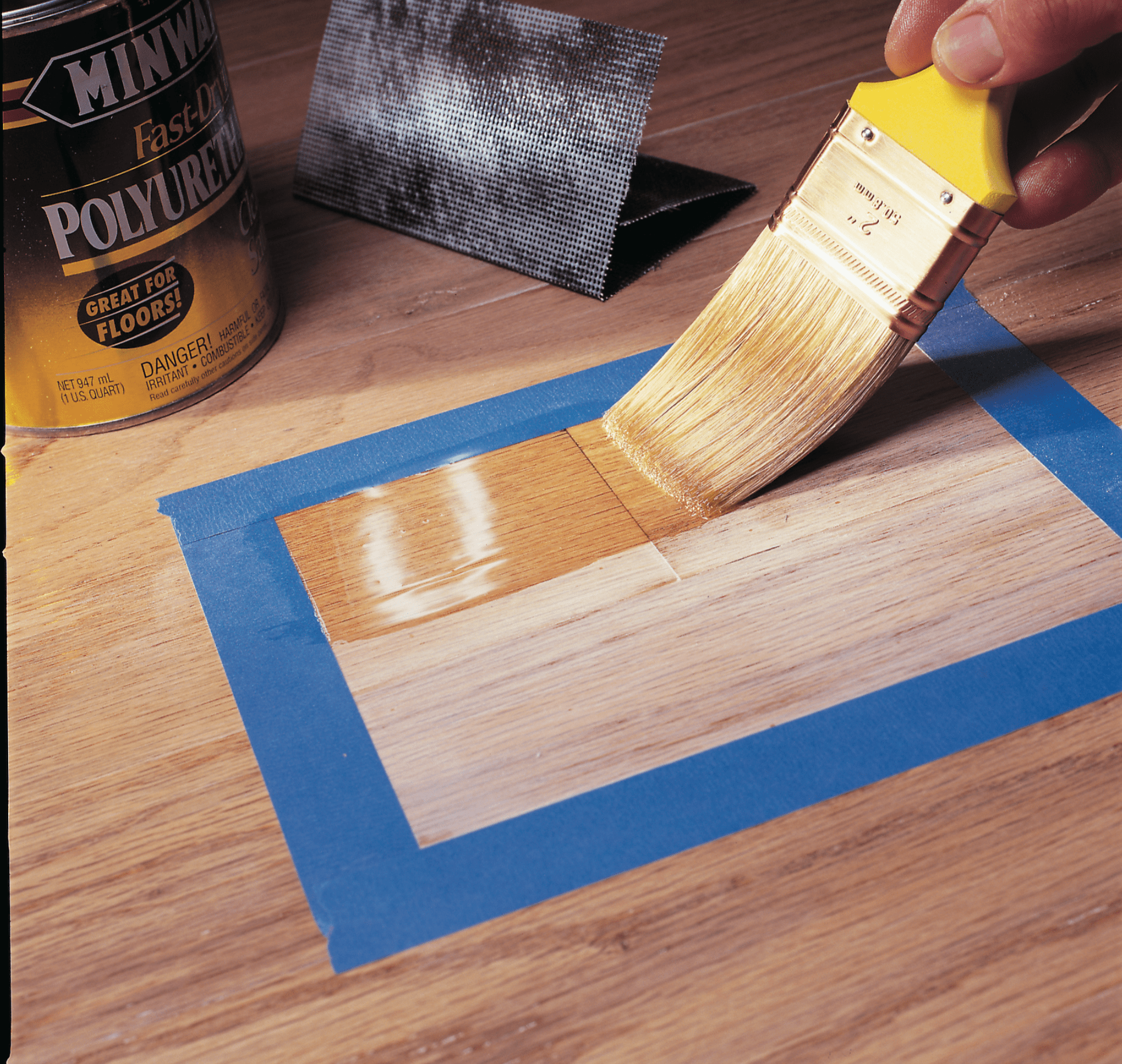
- Pick ii examination areas on the flooring: ane in a high-traffic zone, the other along a wall or in a closet.
- Clean each surface area with a wood floor cleaner and roughen a 6 x six-inch expanse with a sanding screen.
- Wipe abroad the sanding residue.
- Mask around the examination surface area.
- Apply a coat of polyurethane in the masked area.
Step 2
Check for Adhesion
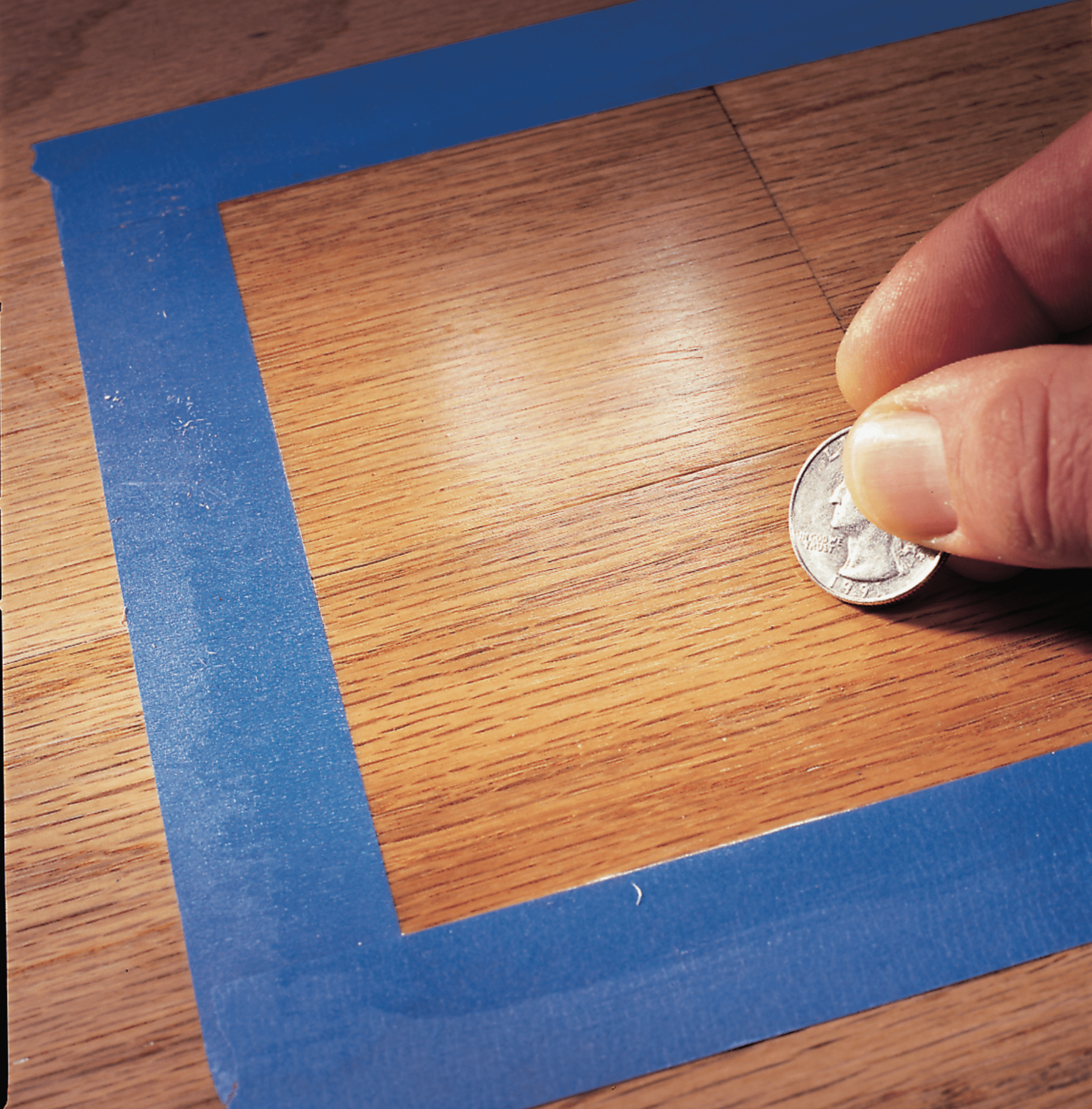
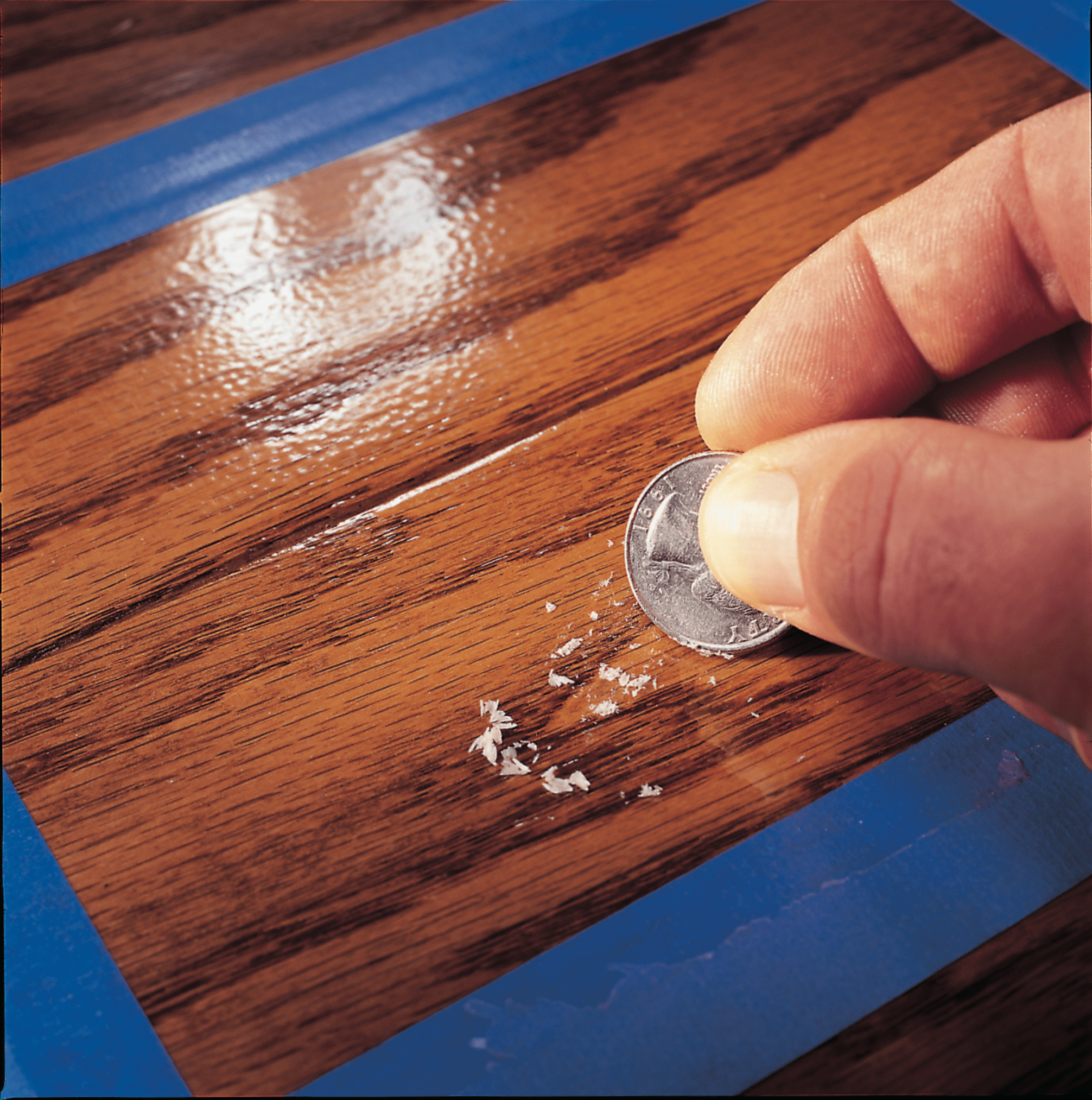
- After the polyurethane has stale 24 hours, scrape a money beyond the test areas.
- Annotation: If no residue scrapes upward, you tin can refinish with screening instead of sanding. If the finish flakes easily, is cracked or has an orange-skin look, you'll demand to sand before refinishing hardwood floors.

Step 3
Make clean the Floor
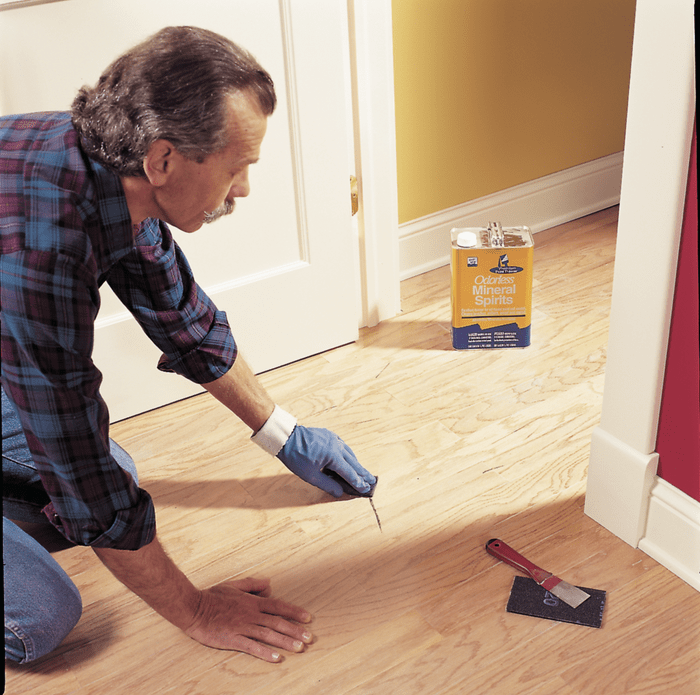
- Scrape away any hardened-on clay with a dull putty knife.
- Apply a scouring pad dampened with mineral spirits for tough areas. If that fails, try a sanding screen.
- Pro tip: As you lot clean, employ pieces of masking tape to marker any deep scratches, ridges or areas where the finish has worn away. You'll take to give these trouble spots special attention (see "Problems Areas" below).
Step 4
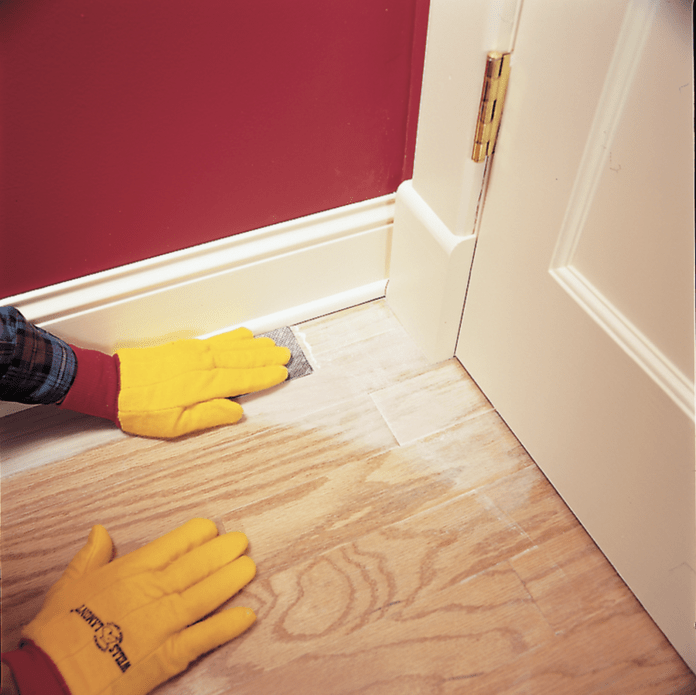
Roughen Corners by Hand
- Roughen the existing cease along walls and in corners where the buffer won't accomplish.
- Note: The purpose is only to scratch upwards the terminate, non to wear information technology down—or worse, sand right through information technology. Three or four passes with the sanding screen are usually enough. Wear gloves to protect your hands from the annoying screen.
Pace 5
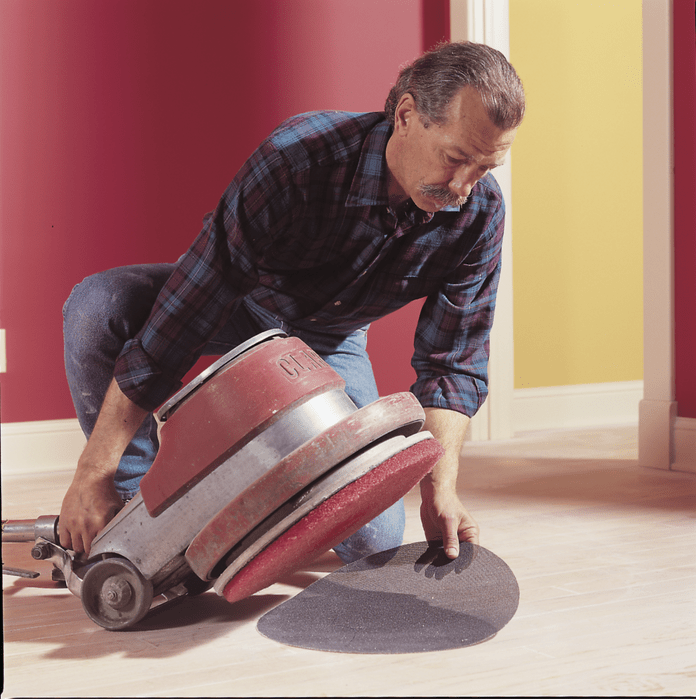
Prepare Upward the Buffer
- Set the buffer over the sanding screen.
- Note: The screen isn't attached to the buffer at all, simply stays put nether the weight of the motorcar.
- Lock the buffer'due south adjustable handle in identify before you begin buffing.
Pace half-dozen
Buff the Floor
- Buff the flooring starting at one wall and moving backward across the room.
- Pro tip: Slowly swing the buffer left and right as y'all get. Pass over each area only once or twice and so you don't cut through the finish. To make the buffer swing to your right, gently lift the handle. Make information technology swing left, by lowering the handle.
- To command dust, place fans in open windows, close ducts, seal off the work area and wear a grit mask.
- Check the screen for grit every few minutes and wipe away any large particles that might scratch the floor.
- Pro tip:The screen will wear out after 10 to 15 minutes of employ. When information technology does, flip it over or start with a new screen.
Tips for Trouble Areas
As you clean and buff the floor, you may find deep scratches that go through the finish and into the wood. Y'all usually can't brand these scratches disappear completely, but y'all tin make them a lot less noticeable. If your flooring is every bit lite or lighter than the floor shown here, showtime wet the scratch with mineral spirits. A wet coat of mineral spirits produces approximately the aforementioned look as a coat of polyurethane. And on a light-colored floor, information technology might darken the scratch just enough to
hide it.
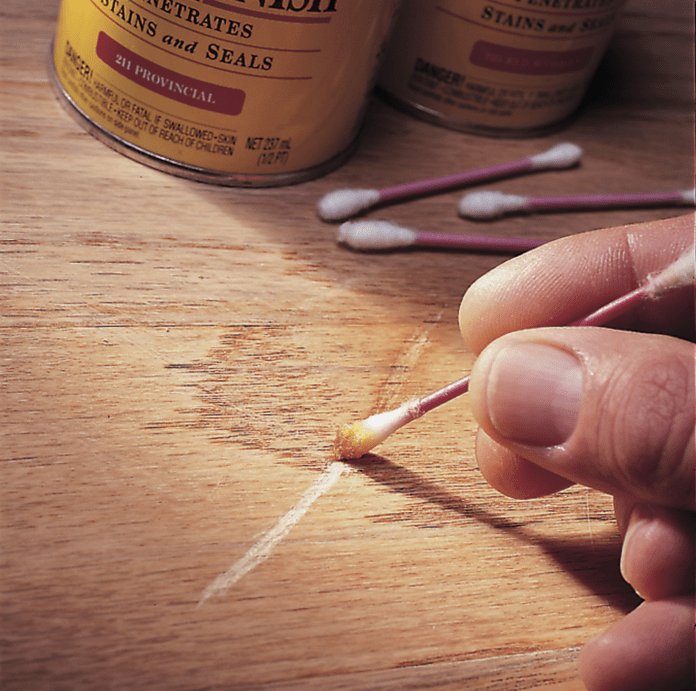
If that doesn't work, apply some wood stain to the scratch using a cotton swab. Considering the scratch is crude and porous, information technology volition absorb a lot of stain. So begin experimenting with a stain that'southward much lighter than the tone of your floor and wipe abroad the excess stain right after you lot employ information technology. For best results, utilize 2 stain colors to match the light and dark patterns in the woods grain (Photo 7).
If your flooring has a high-traffic area where the clear stop is completely worn away, wet the area with mineral spirits to run into what it will look like with a coat of polyurethane. If information technology looks good, clean the area thoroughly, apply a coat of polyurethane and give it at least two days to cure. Then yous can buff and recoat the new polyurethane forth with the remainder of the floor.
Expect out for ridges. The buffer volition consume correct through the cease down to blank wood at high spots. And if your floor is colored with wood stain, y'all'll be left with light-colored strips where the stain has been rubbed off. Photo eight shows how a solid-wood floor can buckle in high humidity. But smaller ridges, where the wood strips cup slightly or one plank sits a chip higher than the side by side, tin cause simply as much problem.

If you tin can flatten a ridge by standing on it, fasten it down with a finishing smash or two. If you can't flatten the ridge, you lot'll have to roughen the expanse by hand using a sanding screen. And remember to avoid that area with the buffer.
Stains that take penetrated through the finish likewise every bit the woods tin only be removed by sanding. Simply in that location'due south no damage in recoating over them—if you tin alive with them
Pace seven
Clean Upwards the Sawdust
- Clean windowsills, moldings and any other surface where dust might gather.
- Vacuum the flooring thoroughly.
- Wipe the flooring with mineral spirits to remove all the sanding dust.
- Pro tip: Apply mineral spirits with a lint-free cloth, and wear an organic vapor respirator to protect against fumes.

Cull a Cease
The all-time floor finish for a do-it-yourselfer is polyurethane. Other flooring finishes are either less durable or much more difficult to work with. You'll notice two types of polyurethane at home centers:
The oil-based polyurethanes (or "oil-modified urethanes") are easier to utilise because they dry slowly, giving you more than time to spread and smooth the stop. They have a yellowish hue and slowly darken with time, which may be skilful or bad for staining hardwood floors depending on the wait you lot want as you're refinishing hardwood floors. The large drawback to oil-based products is the nasty vapor they requite off. Y'all must open windows and wear a respirator.
H2o-based polyurethanes (or "water-borne urethanes") are generally a chip more durable than oil-based versions. They have a milky color when wet, but they dry crystal clear and remain clear. The milky colour makes them easy to see, so you're less likely to miss spots while refinishing hardwood floors. Even so, water-based products are harder to use because they dry fast.
Annotation: With either type of polyurethane, be certain it's recommended for refinishing wood floors before yous buy.
Step 8
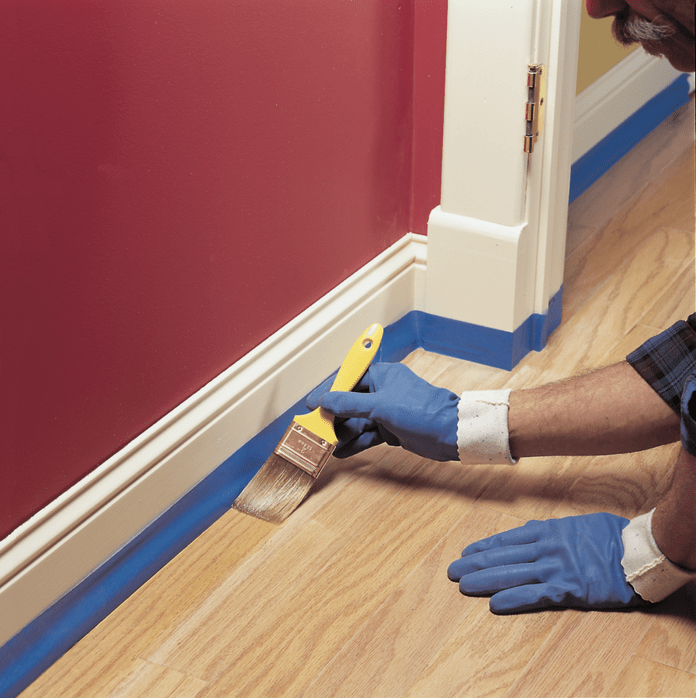
Start at the Walls
- Tape off the baseboards along the perimeter of the floor.
- With your called production, cut in along the outset wall with a high-quality castor.
- Repeat forth the entire perimeter.
- Pro tip: Utilize a natural bristle brush for oil-based urethane or a constructed brush for water-based urethane.
Stride 9
Utilise an Applicator Pad
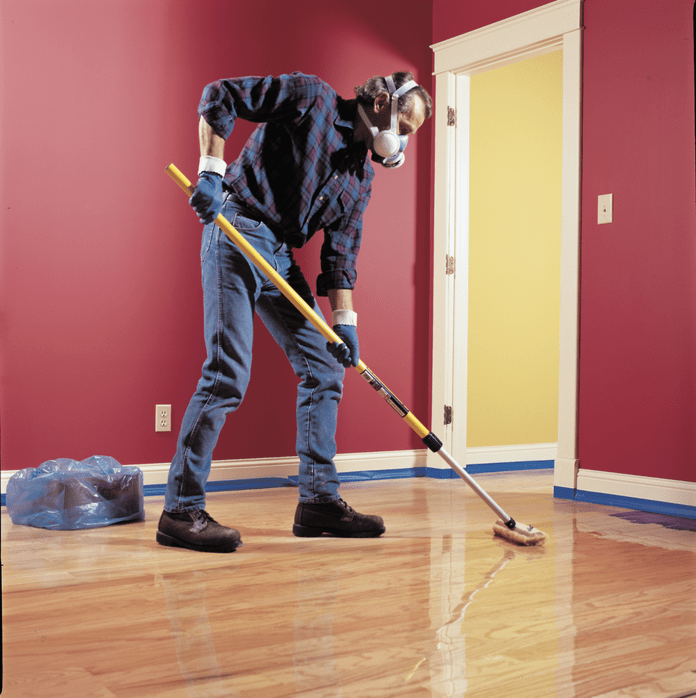
- Utilize polyurethane on large sections of the floor using an applicator pad attached to a long handle.
- Pro tip: When spreading the finish, you can dip the applicator into a paint tray filled with polyurethane, but a cardboard box lined with a plastic bag is less probable to tip over.
- To smooth the finish, "unload" the pad by pressing it hard against a dry function of the floor.
- Elevate the applicator lightly across the floor from one terminate of the room to the other.
Originally Published: Oct 08, 2022

Source: https://www.familyhandyman.com/project/how-to-refinish-hardwood-floors/
Posted by: sengerarte1978.blogspot.com
0 Response to "How To Repair Hardwood Clear Coat Scratches"
Post a Comment