

How To Repair Myelin Sheath
Oct. eleven, 2022
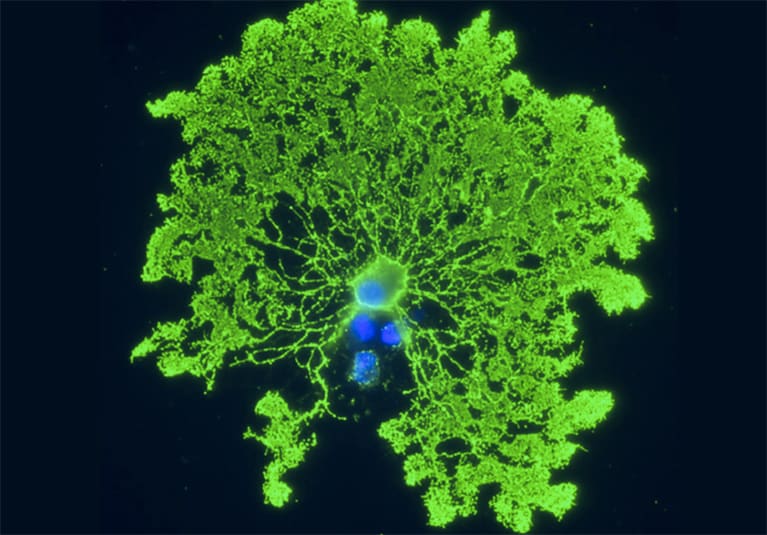
Myelin is essential to the conduction of nerve impulses in the brain and spinal cord, and myelin loss is a central pathophysiological component of neurological injury and illness, including multiple sclerosis, traumatic brain and spinal cord injury, stroke, and some neuropsychiatric disorders.
Identifying factors that encourage production of and protect the function of myelin-producing cells — oligodendrocytes and their progenitors (OPCs) — is an important avenue of research aimed at promoting cardinal nervous system (CNS) health.
In a recently published article in Biochimica et Biophysica Acta (BBA) Molecular Basis of Disease, Isobel A. Scarisbrick, Ph.D., manager of the Neuroregeneration and Neurorehabilitation Laboratory at Mayo Clinic's campus in Rochester, Minnesota, and co-authors investigate the relationship between fat intake, practice and myelin production in mice.
The roles that dietary fatty intake and other external factors play in the product of oligodendrocytes and OPCs is not well-understood. Although encephalon lipids have high fat content, consumption of a diet containing excess fats and sugars has been shown to be detrimental to CNS function. However, myelin assembly requires a significant amount of lipids, and lipids play an important function in glial cell myelination.
Exercise has been shown to have positive effects on CNS function. Contempo inquiry has yielded evidence that exercise tin can modulate the activeness of nutrition on the CNS. Additional animal and human studies accept shown that new myelin formation in the brain is required to learn new skills, whether it's running on an exercise wheel or learning to play the piano or juggle.
"Our study was designed to provide a clearer picture show of the interaction betwixt high fatty consumption and practise training and their effect on myelin and myelin-forming cells in the adult spinal cord," explains Dr. Scarisbrick.
Report methods
Mayo researchers studied adult mice, randomized into four experimental groups: Two groups had a sedentary lifestyle and free admission to a regular diet (SRD) or a high-fat nutrition (SHF). Another 2 groups were assigned to either the regular diet (ERD) or the high-fatty diet (EHF) and had free admission to an exercise running wheel.
Study findings
After seven weeks, researchers analyzed the lumbosacral spinal cord tissue to measure the effects of diet and exercise on several edifice blocks required for myelin assembly in the 4 study groups, including proteolipid poly peptide (PLP) and myelin bones protein (MBP).
- High-fatty nutrition in combination with exercise training increases myelin protein expression. PLP and MBP levels were highest in the grouping that exercised and consumed a loftier-fat nutrition. Practise training or high fat consumption lonely as well increased PLP. MBP levels in the ERD and the SHF groups were not significantly different.
- High-fat diet alone or in combination with exercise has the greatest effect on myelin-related protein expression. The SHF and EHF groups had the highest levels of PLP RNA. Elevations in PLP RNA induced by a loftier-fat nutrition alone (SHF) were significantly greater than those achieved by practise training alone (ERD).
- Exercise preparation protects confronting loss of OPCs or mature oligodendrocytes induced by a high-fat diet. The SHF grouping had 30 to 50 percent fewer OPCs. While practice alone didn't affect the OPC or oligodendrocyte numbers, mice in the EHF grouping did not experience OPC loss.
- Exercise preparation in combination with a high-fatty diet positively modulates expression of IGF-I levels. This growth factor is known to play important roles in OPC proliferation, survival and differentiation. IGF-1 RNA levels were highest in the ERD and EHF groups, suggesting that exercise exerts the greatest influence here.
- High-fat nutrition in combination with exercise converges on energy biosensing systems to restore mitochondrial role and costless radical homeostasis. While SHF mice experienced excessive mitochondrial action and gratuitous radical production, EHF mice upregulated silent mating blazon information training (SIRT1) and the production of free radical scavengers that may protect myelin and myelinating cells from damage in the central nervous system.
These findings suggest that the central nervous system is capable of adapting to the demands of a high-free energy Western nutrition when afforded ample exercise.
"Our results suggest that consuming high levels of saturated fat in conjunction with a sedentary lifestyle can pb to a reduction in myelin-forming cells. But exercise grooming tin can help contrary this process and promote the myelinogenesis necessary to meet increased energy demands," explains Dr. Scarisbrick.
For more than information
Yoon H, et al. Coaction betwixt exercise and dietary fat modulates myelinogenesis in the central nervous system. Biochimica et Biophysica Acta (BBA) Molecular Ground of Illness. 2022;1862:545.

Source: https://www.mayoclinic.org/medical-professionals/physical-medicine-rehabilitation/news/analyzing-the-role-of-diet-and-exercise-in-myelin-production/mac-20429394
Posted by: sengerarte1978.blogspot.com
0 Response to "How To Repair Myelin Sheath"
Post a Comment